Part 6: Serving many adapters over one base model
Part 6: Serving many adapters over one base model
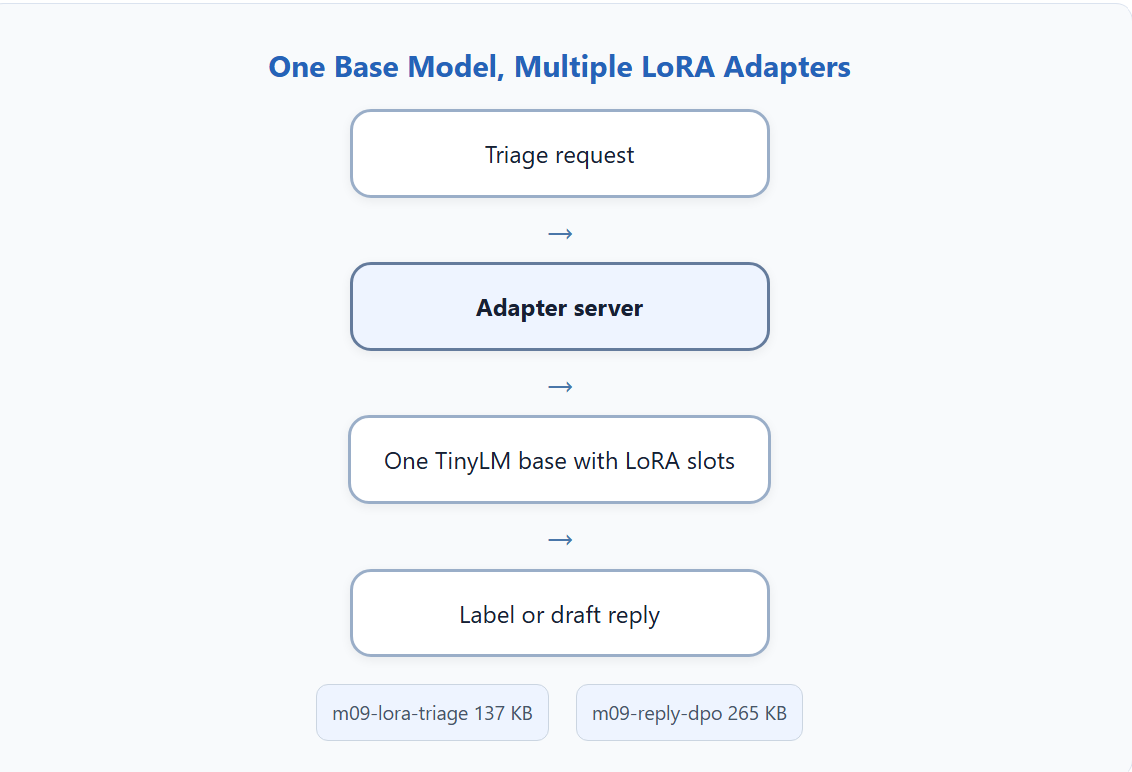
Brightlane now has three adapters over the same TinyLM base: triage, reply SFT, and reply DPO. Deploying three full fine-tuned copies would triple the memory. With LoRA, you load the base once and keep each adapter's A and B matrices, a few hundred KB each, ready to copy into place. Production servers do the same thing at scale and can even mix requests for different adapters in one batch (S-LoRA, Sheng et al., 2023, and vLLM's multi-LoRA support). Here is the single-request version:
examples/m09_serve.py
"""Serve several LoRA adapters over ONE base model: load the base once, swap adapter weights per request."""
import time

import torch

from examples.m09_dpo import fixed_prompt
from examples.m09_lora import add_lora, with_adapter
from examples.m09_setup import MODELS, classify, prompt_for
from supportdesk.data import load_tickets
from supportdesk.tinylm import SamplingParams, generate, load


class AdapterServer:
    """One base model with LoRA slots of rank `max_rank`; each adapter is zero-padded to fit.

    Padding is exact: extra rows of A and columns of B are zero, and each adapter's alpha/r
    scaling is folded into its B, so every adapter computes exactly what it computed alone.
    """

    def __init__(self, max_rank: int = 8) -> None:
        self.model, self.tok = load()
        add_lora(self.model, r=max_rank, alpha=max_rank)  # slot scaling = 1
        self.max_rank = max_rank
        self.adapters: dict[str, dict[str, torch.Tensor]] = {}
        self.active = None

    def register(self, name: str, path) -> None:
        state = torch.load(path, weights_only=True)
        r, alpha = state["meta"]["r"], state["meta"]["alpha"]
        padded = {}
        for key, value in state["lora"].items():
            if key.endswith("lora_A"):
                padded[key] = torch.cat([value, torch.zeros(self.max_rank - r, value.shape[1])])
            else:
                padded[key] = torch.cat([value * (alpha / r), torch.zeros(value.shape[0], self.max_rank - r)], dim=1)
        self.adapters[name] = padded

    @torch.no_grad()
    def use(self, name: str) -> float:
        """Copy one adapter into the LoRA slots; returns milliseconds spent (0 if already active)."""
        if name == self.active:
            return 0.0
        started = time.perf_counter()
        params = dict(self.model.named_parameters())
        for key, value in self.adapters[name].items():
            params[key].copy_(value)
        self.active = name
        return (time.perf_counter() - started) * 1000


if __name__ == "__main__":
    started = time.perf_counter()
    server = AdapterServer(max_rank=8)
    base_ms = (time.perf_counter() - started) * 1000
    for name in ("m09-lora-triage", "m09-reply-sft", "m09-reply-dpo"):
        server.register(name, MODELS / name / "adapter.pt")
    print(f"base loaded once in {base_ms:.0f} ms; adapters registered: {list(server.adapters)}")

    # Exactness check: padded adapter in the server == the adapter loaded on its own.
    x = torch.tensor([server.tok.encode(fixed_prompt(0)).ids])
    server.use("m09-lora-triage")
    alone = with_adapter("m09-lora-triage")
    with torch.no_grad():
        print("max logit difference vs standalone adapter:", float((server.model(x) - alone(x)).abs().max()))

    tickets = load_tickets("test")[:3]
    requests = [("triage", t) for t in tickets] + [("reply", 10), ("triage", load_tickets("test")[3]), ("reply", 11)]
    swaps = []
    for kind, item in requests:
        if kind == "triage":
            ms = server.use("m09-lora-triage")
            out = classify(server.model, server.tok, prompt_for(server.tok, item))
            label = item.id
        else:
            ms = server.use("m09-reply-dpo")
            out = generate(server.model, server.tok, fixed_prompt(item),
                           SamplingParams(max_new_tokens=30, temperature=0, stop=["\n"])).text.strip()
            label = f"question {item + 1}"
        if ms:
            swaps.append(ms)
        print(f"  {kind:<6} {label:<11} swap {ms:5.2f} ms  -> {out[:70]!r}")
    timings = []
    for _ in range(50):
        server.active = None
        timings.append(server.use("m09-reply-dpo"))
    timings.sort()
    started = time.perf_counter()
    load(MODELS / "m09-full")
    full_ms = (time.perf_counter() - started) * 1000
    print(f"adapter swap: median {timings[25]:.2f} ms over 50 swaps; loading a full fine-tuned model from disk: {full_ms:.0f} ms")
Code explained
- In simple words: one base model in memory with empty LoRA slots; each request copies its task's adapter into the slots, which takes a fraction of a millisecond.
- What happens:
AdapterServer.__init__loads the base once and adds LoRA slots of rankmax_rank(8) with alpha equal to the rank, so the slot's scaling is 1.registerreads an adapter file and pads it to the slot size: extra rows of A and columns of B are zero, so they add nothing. Each adapter's own alpha / r is folded into its B, so a rank-4 adapter with scaling 2 computes exactly what it computed alone.usecopies the adapter's tensors into the slots in place (no new model, no reallocation) and times it. It does nothing if that adapter is already active.- Main: register three adapters, prove exactness (the maximum logit difference between the server and the standalone triage adapter), serve a mixed stream of triage and reply requests, time 50 swaps, and time loading a full fine-tuned model from disk for comparison. Run it with
python -m examples.m09_serve.
- Comes out:
base loaded once in 32 ms; adapters registered: ['m09-lora-triage', 'm09-reply-sft', 'm09-reply-dpo']
max logit difference vs standalone adapter: 0.0
  triage T-1003      swap  0.00 ms  -> 'cancellation'
  triage T-1006      swap  0.00 ms  -> 'how_to'
  triage T-1009      swap  0.00 ms  -> 'how_to'
  reply  question 11 swap  0.23 ms  -> 'Thank you. Team costs 12 USD per user per month. Business costs 24 USD'
  triage T-1012      swap  0.19 ms  -> 'billing'
  reply  question 12 swap  0.19 ms  -> 'Thank you. Please check status.brightlane.example for live updates.'
adapter swap: median 0.11 ms over 50 swaps; loading a full fine-tuned model from disk: 23 ms
The padded adapter reproduces the standalone model exactly (difference 0.0). A swap takes about 0.1 to 0.2 ms, against about 23 ms to load a full fine-tuned TinyLM from disk and about 30 ms for the base. For TinyLM both are fast. For a 7B model, loading a full copy means gigabytes and seconds, while an adapter swap stays in the milliseconds, which is why "one base, many adapters" is the standard way to serve per-task or per-customer fine-tunes. The ratio, not the absolute number, is what transfers. (The triage outputs here are the adapter's usual mistakes: T-1006 and T-1009 are wrong, as Part 4 predicted.)
| Situation | Use this | Why |
|---|---|---|
| One fine-tuned task, latency-critical | Merge the adapter into the base (merge_lora) | Zero extra compute per token |
| A few tasks on one deployment | One base with swappable adapters | One copy of the big weights; swap cost is negligible |
| Many tenants or tasks with concurrent traffic | A server with batched multi-LoRA (vLLM, S-LoRA-style) | Different adapters in one batch without swapping |
| Tasks that need different base models | Separate deployments | Adapters only fit the base they were trained on |